
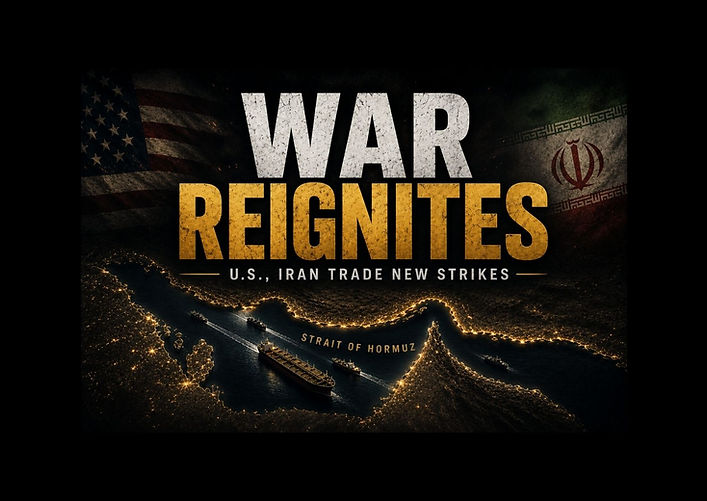
Iran War Reignites as U.S., Iran Trade New Strikes
The United States and Iran exchanged new strikes around the Persian Gulf after commercial vessels were attacked in the Strait of Hormuz, pushing the interim ceasefire back toward open war.
World
7/8/26
10:00 PM
477
Crisis Mode
Middle East
UPDATE — July 8, 2026: The U.S. struck targets in Iran after attacks on commercial ships in the Strait of Hormuz.
Iran responded with missile and drone attacks aimed at U.S. sites in Bahrain and Kuwait, while Trump said the interim ceasefire was "over."
What Happened
The United States conducted military strikes against Iranian air defense systems, radar sites and Revolutionary Guard maritime assets after three commercial vessels were attacked in the Strait of Hormuz. Iran retaliated by targeting U.S. military installations in Bahrain and Kuwait with missiles and drones.
The U.S. also revoked sanctions relief that had allowed Iran to openly sell oil under the interim agreement. Speaking at the NATO summit in Ankara, President Trump declared the ceasefire "over" while leaving the door open to continued negotiations.
What We Know
The U.S. military struck Iranian air defense systems, radar installations and more than 60 Revolutionary Guard fast boats. U.S. officials said the operation was in response to attacks on three commercial vessels in the Strait of Hormuz.
Iran acknowledged launching missiles and drones toward U.S. military facilities in Bahrain and Kuwait. Kuwait reported intercepting two ballistic missiles and thirteen drones. One commercial tanker caught fire following the maritime attacks; two other vessels sustained damage and continued sailing.
The United States revoked the license permitting Iran to openly sell oil under the interim agreement. Brent crude oil prices rose sharply following the renewed fighting and Trump's comments. President Trump stated, "For me, I think it's over," referring to the interim ceasefire, while also saying negotiations could continue.
What We Do NOT know
It remains unclear whether the interim agreement has been formally terminated by both governments, whether additional U.S. military operations are planned, whether Iran intends further retaliation beyond Wednesday's strikes, whether negotiators will proceed with planned talks following Ayatollah Ali Khamenei's funeral, the full extent of damage to Iranian military infrastructure and commercial shipping, and whether additional Gulf countries will become directly involved.
Why It Matters
The exchange signals a shift from strained diplomacy back toward active hostilities.
Attacks on commercial vessels and Iranian strikes near U.S. bases in Bahrain and Kuwait could widen the conflict, disrupt energy flows through the Strait of Hormuz, and make any final agreement harder to reach even if talks remain technically open.
Coverage Snapshot
Reporting indicates a rapid deterioration in the security environment surrounding the Strait of Hormuz following renewed military exchanges.
Analysts are monitoring whether diplomatic negotiations continue despite Trump's remarks, whether maritime attacks persist, and how global energy markets respond if commercial shipping faces further disruption.
Bias Summary
Reuters emphasizes the geopolitical and market implications of Trump's declaration and the renewed military exchanges, while the Associated Press provides additional operational detail on the strikes, shipping incidents and diplomatic timeline.
Both organizations distinguish between Trump's statement that the ceasefire is "over" and the fact that negotiations have not yet been formally abandoned.
Blindspot Check
Iran has not formally announced that negotiations are ending. The long-term status of the interim ceasefire remains legally and diplomatically unclear.
Independent verification of some battlefield claims remains limited. The strategic calculations behind revoking Iran's oil sales license and its effect on future negotiations remain underreported.
The broader impact on Gulf shipping insurance, commercial traffic and regional military readiness continues to develop.
Follow The Signal


Media Credits
Media: Renegade Chronilces (AI)
Associated Press • Reuters


Tags